

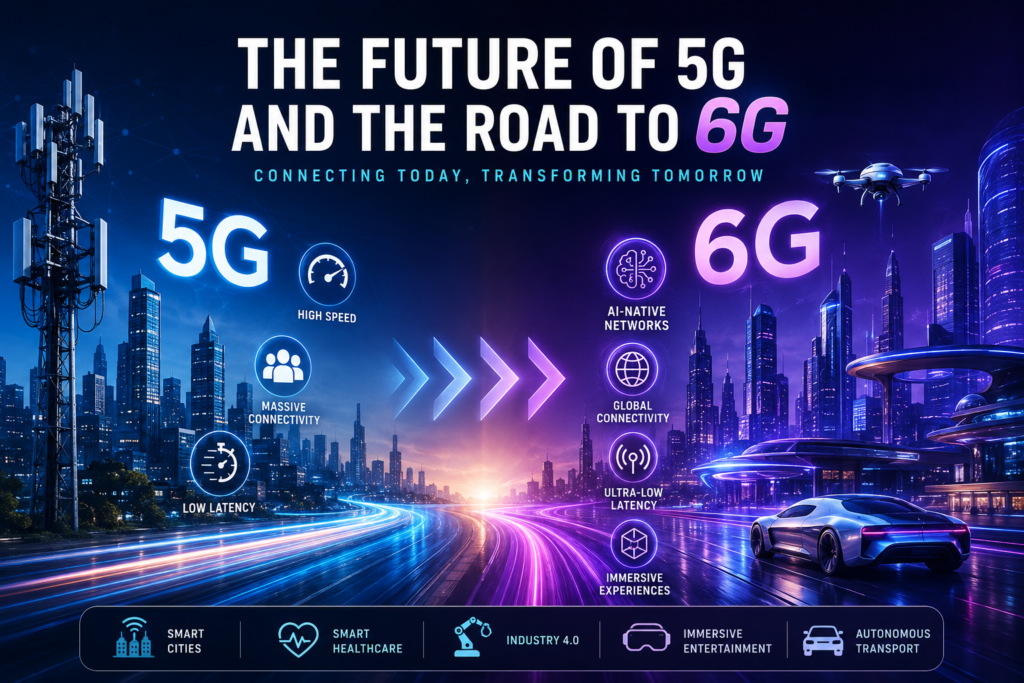
Wireless communication has evolved over the past century or so. From the first mobile networks that enabled voice communication, the current 5 G networks, and everything in between. The world is currently witnessing the dawn of the 5 G networks that will shape the future of businesses and consumers. Researchers and companies have already begun to develop technologies beyond 5 G networks.
The future of wireless communication beyond 5 G networks will enable smart cities, autonomous cars, artificial intelligence (AI), robotics, smart manufacturing, entertainment, and much more than ever imagined.
In this essay,
we will discuss the impact of 5 G networks on the world, the limitations of 5 G networks, the future of 6 G and beyond, and the future of wireless communication for humanity in ten years.
What is 5 G?
The fifth-generation technology knows as 5 G has been launched and is expected to become the new standard for mobile networks. Fifth-generation networks are expected to be faster, more reliable, and offer higher capacity than the fourth-generation long-term evolution (4 G LTE) networks. Fifth-generation networks will enable faster access to data than ever before compared to the 4 G LTE networks, thus, creating new business models.
How fast is 5 G?
Depending on the network provider and location, 5 G networks will be able to deliver more than a gigabyte per second, ultra-low latency networks with less than one to ten-millisecond response time, massive connective networks that will offer better performance than ever before in large-scale networks with many users, and much more than 4 G networks.
Significance of 5 G.
5 G networks are projected to be more than an evolution of the 4 G LTE networks; instead, they are set to catalyze future breakthroughs in AI, the Internet of Things (IoT), smart cities, healthcare, advanced manufacturing, farming, entertainment, and more.
Existing application of 5 G
Smart cities are the future, and 5 G networks will enable future smart cities. Smart mobility, the transport system, will be the highlight of future smart cities that will be powered by 5 G networks. Moreover, smart parking, public transport, street lights, waste management, smog reduction, and flood management are some of the other applications that 5 G networks will enable.
Healthcare.
Healthcare is set to be transformed by the 5 G network. The healthcare industry has been digitalized due to the adoption of mobile technologies. The 5 G network will enable telehealth, AI diagnosis, remote healthcare, and connected medical devices. Moreover, healthcare workers will be able to provide better patient care by leveraging on the ultra-low latency enabled by the 5 G networks.
Advanced manufacturing.
Advanced manufacturing applications comprise a wide range of connected robots and sensors. The 5 G networks will enable connected and automated manufacturing functions, thus leading to smart manufacturing.
Education.
Education will witness a rise in connected learning and be empowered by the 5 G networks. With the prevalence of online learning, virtual classes and reality will be enabled by the new mobile network. In addition, students will be able to access virtual laboratory resources and other learning materials directly from the network without the need for a personal computer.
Entertainment.
The entertainment industry will be transformed by the 5 G network. The ultra-fast connection of the new network will be a game-changer for connected entertainment such as cloud gaming, VR, and video streaming. In addition, video conferencing applications will benefit from the new network because it will be possible to deliver higher-resolution videos.
Limitations of 5 G.
5 G networks have faced several challenges since their launch, thus, slowing down their development. Some of the challenges associated with 5 G networks include high costs, coverage, availability of devices, and security.
Why the world is focusing on 6 G.
Technologies have been evolving at an exponential rate, hence, the need for faster internet. Although the 5 G networks have been launched, researchers are already working on future networks beyond 5 G. One of the main reasons is that future technologies such as AI and robots will require a better communication platform.
What is 6 G?
Sixth-generation technology, referred to as 6 G, is projected to be launched by 2030. 6 G is expected to enable intelligent communication networks that will be empowered by artificial intelligence (AI) to drive next-generation applications. Unlike the 5 G networks, which will focus on connecting devices at ultra-fast speeds, 6 G will be able to comprehend communication patterns and optimize operations.
Some of the features that are expected to be possible with 6 G networks include:
Terabyte internet speed.
The 6 G network is expected to offer internet speeds that are as high as one terabyte per second. This will ensure it is possible to download high-definition movies within a short time.
Ultra-low latency networks.
The 6 G network will be able to offer response rates below one millisecond. The latency of less than one millisecond will enable AI surgery, autonomous cars, and industrial automation.
AI-driven networks.
The 6 G network will make extensive use of artificial intelligence to enhance performance while boosting the user experience. Artificial intelligence will be leveraged to optimize traffic control, increase energy efficiency, improve signal integrity, and enhance network security.
Global coverage.
Satellites will be utilized together with the 6 G network to offer internet access to all people. People living in remote areas such as mountainous and coastal areas will be able to access the internet with ease.
Integrated communication and sensing.
The 6 G network will utilize communication and sensing to enable smarter applications that will be powered by AI, IoT, autonomous cars, and other fields.
Industries that will benefit from 6 G.
Healthcare.
Healthcare will be revolutionized by the 6 G network. For instance, doctors will be able to perform robotic surgery with better precision enabled by ultra-low latency rates of the 6 G network.
Transportation.
Transportation applications will be smarter and more efficient with the 6 G networks. Autonomous cars will be able to operate efficiently and safely enabled by the ultra-high-speed internet of the 6 G network.
Artificial intelligence.
AI will benefit significantly from 6 G networks. The improved communication will enable AI devices to communicate effectively, thus, leading to better language models, AI robots, and virtual assistants.
Smart factories.
Smart factories will leverage on the ultra-high-speed internet and AI of the 6 G network to carry out highly sophisticated manufacturing processes.
Space communication.
Satellite systems can be utilized together with the 6 G network to enable better space communication while facilitating space research activities.
5 G vs 6 G Comparison.
Feature
5 G
6 G
Speeds
Up to several Giga bits per second
Up to 1 tera bit per second
Latency
1-10 ms
<1 ms
AI-enabled
No
Yes
Device connectivity
Millions
Billions+
Smart cities
Yes
Enhanced
VR and AR
Yes
Immersion
Automation
Yes
Full automation
Will 6 G replace 5 G?
The fifth and sixth-generation networks will co-exist because it takes a relatively long time to transition from one cellular network to the other. In addition, it is quite likely that the fourth-generation (4 G) networks will continue to complement the 5 G networks for a relatively long time. Most consumers will not feel the transition from the 5 G to the 6 G network because businesses will gradually adopt the new network.
Sustainability and the future of wireless communication
Researchers are working on future cellular networks that will be energy-efficient and support next-generation applications. Future networks will be able to consume less power while leveraging on other related technologies to enhance performance while minimizing the impact on the environment.
Privacy and security.
The future of wireless communication will involve enhanced data security measures to ensure that personal data is well protected. For instance, researchers are considering relying on artificial intelligence to enhance network security and offer better protection against cyber-attacks.
Challenges and future of wireless communication.
The future of wireless communication comes with its challenges, and it is essential to address the limitations of future networks such as 6 G. For instance, sixth-generation networks will be expensive due to the need for upgraded infrastructure. Some of the other limitations of the sixth-generation networks include spectrum research, global collaboration, and power consumption. Future networks will also require enhanced privacy and security measures to ensure data confidentiality.
What businesses should do now.
Businesses need to invest in future technologies to ensure they are well-positioned to leverage on the new developments to transform their operations and propel them to new heights. Some of the futuristic approaches that will enable future-readiness and growth include investing in cloud technology, adopting AI and IoT, and enhancing cybersecurity measures. However, businesses need to invest in future skills, thus, preparing their workforce for the upcoming changes.
What consumers can expect.
Consumers can expect that future wireless communication will enable new products and disruptive services. Some of the exciting developments that consumers can anticipate within the next decade include ultra-fast internet, advanced smartphones, smart devices, and virtual reality. Moreover, there will be a proliferation of cloud gaming, online education, telehealth, and connected devices.