

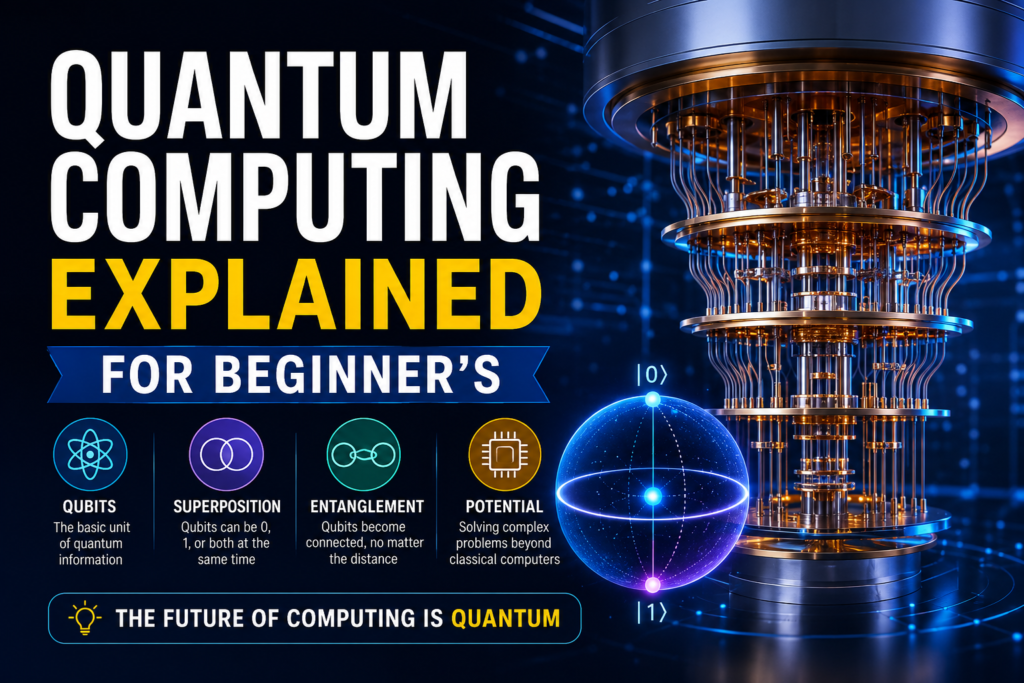
Quantum computing is one of the most fascinating concepts of this century, and experts consider it to be a latent space. Experts claim that the creation of quantum computers will bring forth a revolutionary breakthrough in the world that we all know and have lived in for a relatively short time. The areas that stand to benefit from quantum computing include healthcare, financial services, cyber security industry, artificial intelligence, logistics, and research, among others. The purpose of this article is to give a beginner’s guide to quantum computing and its significance. In addition, the article will also intrigue the reader about upcoming cutting-edge developments.
What Is Quantum Computing?
Quantum computing is the type of computing that uses quantum physics to solve, manipulate, and process specific computing problems that conventional computers cannot handle or process faster.
How It Works:
Unlike the traditional computers that use bits to store information, quantum computers on the other hand use qubits or quantum bits.
The former can store either 0 or 1 , but the latter can store 0 , 1 or both at the same time due to superposition. The principle of superposition allows a quantum computer to carry more information than the capacity of classical computers. Classical Vs. Quantum Computers
Classical
Quantum
Uses bits Uses qubits
Bit can be 0 or 1 Qubit can be 0 or 1 or both simultaneously
Good for regular tasks Good for intensive calculations
Found everywhere Mostly used in research labs
Well-developed Relatively new
As demonstrated in the table above, quantum computers will not replace the special personal computers (PCs) that we use to perform average tasks on a daily basis since they are not designed for such activities.
What Is A Qubit?
As explained earlier, qubits are the quantum counterpart of the bits used in decimal computers. To have a better understanding of how qubits work, take a look at this analogy: regular Computers Qubits Regular computer stores information as a coin tossed on a table – either heads (1) or tails (0). A qubit works like a spinning coin – the spin enables the coin to depict both heads and tails until it settles on one of them. This phenomenon is called superposition .
Explanation Of Superposition Superposition can be best explained using the analogy of searching for a particular key. Imagine that you have a million keys in front of you and you need to find out which of these keys opens the door. With the traditional computing approach, you would have to try all the keys until you find the right one. On the other hand, the superposition principle enables you to try all the keys at the same time until you find the right key.
What Is Entanglement?
Another interesting concept found in quantum computers is entanglement which allows the copying of information from one qubit to another directly without having to measure the qubits. Quantum physicists hope that they can use the power of entanglement to make faster quantum computers that can solve problems way faster than the conventional computers. The Role Of Gates In Quantum Computing Similar to how logic gates (AND, OR, NOT) enable regular computers to perform operations, quantum gates enable quantum computers to perform unique operations.
Why Is Quantum Computing Important?
It has been said that quantum computers can solve problems that previously took an unreasonable amount of time to solve with conventional computers. These are some of the fields that will benefit from the new paradigm of faster computing. Quantum Computing Applications In Different Fields Drug Development And Healthcare Simulations will be much faster which will lead to faster drug discovery and development, vaccines, and various other medical treatments. Apart from that, personalized medication will become much more accessible. Artificial Intelligence Quantum AI is the future, and it is much more powerful than traditional machine learning. It will enable us to achieve greater heights and make groundbreaking discoveries in the field of artificial intelligence and machine learning. Additionally, it may help create better algorithms for traditional computers. Cyber Security And Crypto Quantum computers can be a double-edged sword in terms of cybersecurity. Whereas it can break conventional encryption, it may also help create unhackable systems using more advanced algorithms. Financial Services Financial services such as trading, banking, fraud detection, and insurance can benefit immensely from the much faster and efficient processing power made possible by quantum computing. Logistics Companies can use quantum computing to optimize delivery routes and other logistics aspects such as workforce management and inventory management to make their operations as efficient as possible. Climate Research Quantum computers can help humanity in its search for alternative clean energy sources, optimize the performance of the existing ones, and study climate change and its effects.
Which Industries Can Benefit From Quantum Computing?
Various industries are considering the benefits that quantum computers can bring them. Some of these industries include healthcare, banking, manufacturing, aerospace, automobiles, telecom, energy, government, defense, artificial intelligence, and other high-tech industries.
Potential Challenges Of Quantum Computing.
Like with any other technology, quantum computing also comes with its own challenges. Some of these challenges include the following: It has been predicted that quantum computers will be so expensive that only the top 1% of the world’s population can afford them. In addition, quantum computers have to be kept at extremely low temperatures for them to function. They are very sensitive to their environment. Currently, quantum computers can only be used by big organizations.
Does Quantum Computing Replace Traditional Computing?
Traditional computers will continue to serve their purpose of dealing with simple computations, and quantum computers will only be used to address more complex problems. The two can co-exist in harmony.
Who Are The Major Players In Quantum Computing?
There are several companies and organizations that are vying to be the best in quantum computing and quantum hardware. Some of the major players in this field include Google, IBM, Microsoft, Amazon, Intel, IonQ, Rigetti, and D-Wave. These companies design quantum processors, software, and cloud-based quantum computers.
Can I Learn About Quantum Computing?
Learning about quantum computing will not be as hard as you think, and anybody can do it. You do not need to be a physics genius to be able to understand it. However, you might need to brush up on your linear algebra skills and learn how to code in Python and Qis kit (quantum python). There are various resources that can help you learn more about quantum computing.
What Is The Future Of Quantum Computing?
Experts believe that the future of quantum computing is bright, and we can expect to see exponential growth in this field. According to some sources, we are on the verge of entering the quantum era in fields such as artificial intelligence, healthcare, materials science, and battery technology. The future of quantum computing can also bring about much faster networks that will facilitate better space exploration and analyzing climate data so that we can combat climate change before it is too late.
Myth Or Fact:
Myth 1: Quantum computers will replace my laptop with a faster one. Fact: Actually, quantum computers will not replace traditional computers because there are various limitations.
Myth 2: Quantum computers are magic. Fact: Actually, they are not. Quantum computers follow real physical principles.
Myth 3: I can use a quantum computer anytime I want. Fact: Unfortunately, no. They are only available to certain organizations.
Myth 4: I cannot understand how quantum computing works.
Fact:
Actually, you can. You only have to do some research and have patience.