

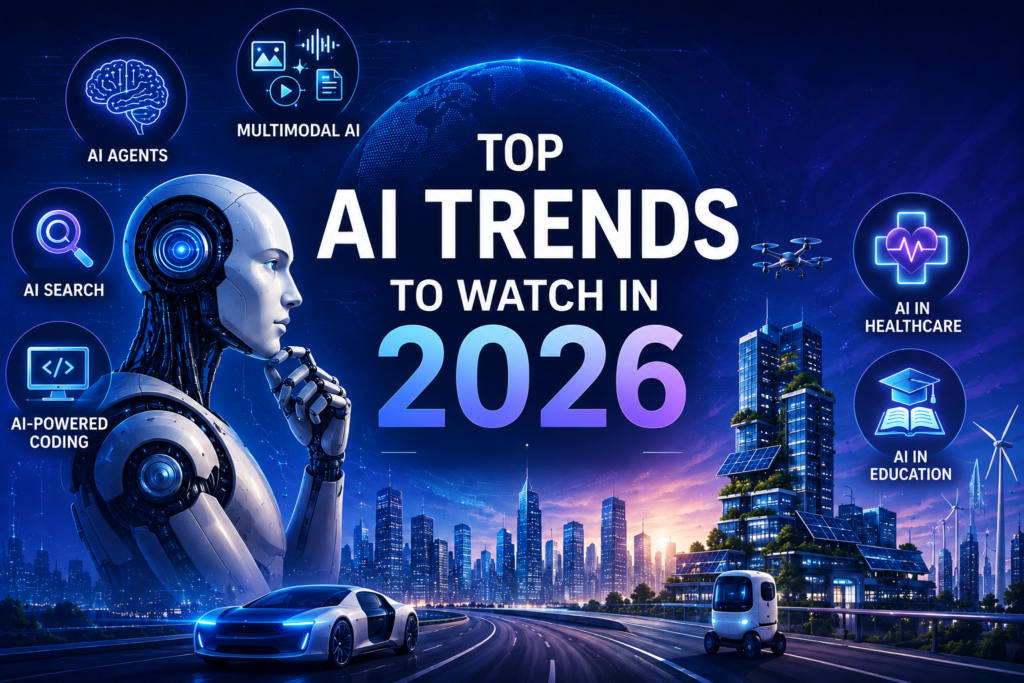
Artificial Intelligence trends have been evolving steadily for several years. From chatbots and virtual assistants to autonomous cars and medical breakthroughs, AI is changing the world around us. In 2026, artificial intelligence trends are taking off, enabling new innovations at an unprecedented scale and fundamentally reshaping the way humans work, study, learn and communicate.
With billions of dollars being invested in research and development, governments developing AI strategies, start-ups being bought for billions, and consumers embracing AI products at an astounding rate, it is fair to say that we are currently witnessing nothing less than an AI revolution that will shake up the global economy.
Whether you are a student, business owner, content creator, software developer, or simply a curious mind, you must familiarize yourself with AI trends to understand what the future holds for the digital world.
In this article, you will learn the top artificial intelligence trends that will shape 2026 and beyond, and how they will impact businesses, workers, students, healthcare, cybersecurity, and your everyday life.
Top 6 AI Trends to Watch Out For in 2026
1. AI Agents Will Become Your Digital Employees
AI agents are among the most exciting emerging trends in artificial intelligence.
While chatbots are typically good for answering questions, AI agents go far beyond and perform tasks and actions like human employees.
For example, modern AI agents can schedule meetings, send and reply emails, perform research, analyze reports, manage projects, write documents, automate processes, and much more.
Many companies are already using AI agents to transform and improve operations. By delegating mundane and repetitive tasks to AI assistants, businesses can dramatically increase productivity and efficiency.
AI agents will become commonplace in the workplace as they enable businesses to operate with minimal human intervention.
2. Multimodal AI Will Become the Norm
A few years ago, most AI systems could only understand and generate one type of information, e.g., text.
However, modern AI models can comprehend and produce several types of data, including text, images, audio, video, and more.
For example, you can ask AI to describe what is in the photo, answer questions about the image, generate articles from photos, extract text from photos, summarize videos, analyze excel files and word docs, and much more.
Multimodal AI will allow businesses to offer better digital experiences to customers while also transforming how enterprises operate.
Moreover, since multimodal AI can understand and respond to voice commands, images, and text, it will be incorporated into smart homes, healthcare, and education.
3. People Will Use AI Search Engines Instead of Google
Consumers are already becoming dissatisfied with traditional search engines and are demanding more intelligent search alternatives.
In 2026, search engines will be intelligent and assisted by artificial intelligence. Google and other traditional search engines will be replaced by AI assistants that can answer questions accurately and in a more conversational manner.
For example, instead of searching for online articles, you can ask an AI search engine to summarize the latest news on a particular topic. You can also use an AI search engine to help you find products, compare their features and prices, explain specific topics, write articles, create travel itineraries, study guides, research papers, and much more.
This technological innovation will disrupt the traditional publishing and SEO industries since articles and webpages will need to be optimized to be compatible with AI search engines.
4. Healthcare and Hospitals Will Use AI to Improve Patients’ Experience
Healthcare and hospitals are among the most promising areas where AI trends will have a tremendous impact. Doctors will be assisted by AI systems during diagnosis, while nursing staff will use robotic assistants to carry out specific tasks. Moreover, AI-enabled devices will allow patients to monitor their health conditions and prevent illnesses.
Some hospital networks are already using artificial intelligence to improve patient care, reduce human errors, and cut healthcare costs.
5. Software Developers Will Use AI Code Assistants to Build Amazing Apps Faster
Modern software developers are already using amazing AI coding assistants to be more efficient and productive.
In 2026, developers can use AI coding tools to write computer programs, identify and fix bugs, optimize code, explain algorithms, and much more.
For example, AI coding assistants will allow developers to generate documentation automatically and convert computer code from one programming language to another. While some software developers fear that AI will make their jobs obsolete, coding assistants will only make them more productive.
Most small businesses and independent developers will use AI coding assistants to build websites and mobile apps faster and begin profiting from their products sooner.
6. Students Will Use AI Tutoring Platforms to Excel in Their Studies
Students are among the most significant beneficiaries of modern AI trends.
The future of education involves AI tutors that can help learners improve their academic performance. These AI tutors can explain complex concepts in simple terms and test students’ knowledge and skill level.
Moreover, AI education platforms can recommend learning resources based on students’ needs and preferences.
Teachers can also use AI tools to design lesson plans, develop tests and quizzes, mark assignments, and analyze student performance. This disruptive innovation will profoundly impact the education sector by making learning easier and more personalized. Students can use AI tutors to practice and improve their language skills, coding, mathematics, physics, and other subjects.
Conclusion
Artificial Intelligence trends in 2026 will disrupt businesses, students, education, healthcare, cybersecurity, and many other industries. However, these seemingly futuristic technologies are already being used by enterprises, students, doctors, and developers to transform their workflows and become more productive.